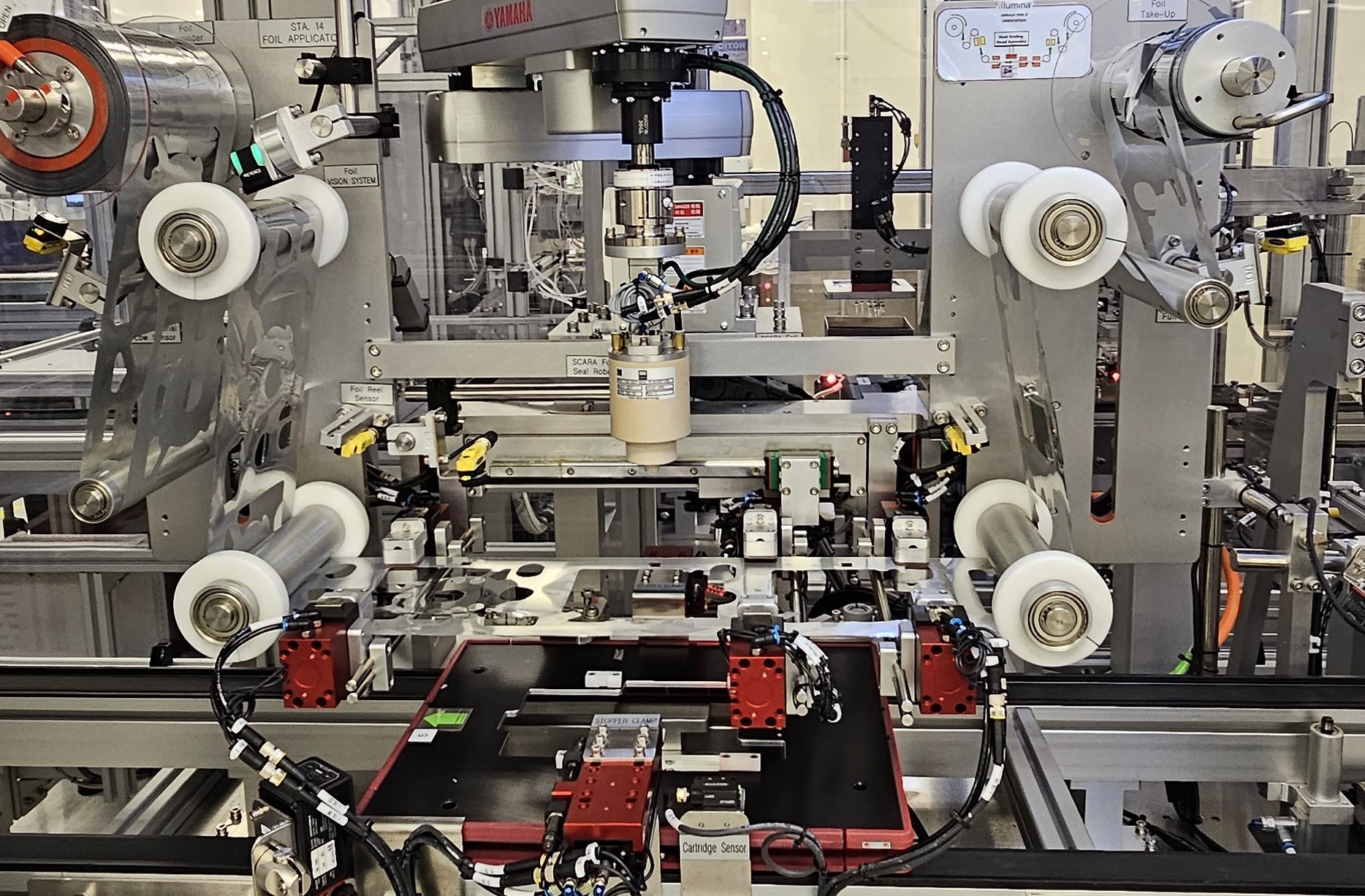
Relco is a trusted provider of precision induction sealing solutions for medical devices, pharmaceuticals, and life sciences. Recently, we partnered with a medical device company and a life sciences startup to deliver a reliable, repeatable sealing solution for a critical component.
Their goal: achieve consistent, tamper-evident seals without relying on thermal methods, which lacked precision. Using a combination of our MIT-2 induction sealing machine for trials and the FCS2 semi-automatic reel-fed system for production, we successfully completed the project in just a few months.
Why Induction Sealing Matters in Medical Devices
Induction sealing is a non-contact electromagnetic sealing process that provides:
- Hermetic, tamper-evident seals
- Consistent, repeatable results
- Compatibility with diverse container materials and sizes
- Integration with automated production workflows
For medical devices, precision and reliability are critical. Even small sealing inconsistencies can compromise safety, sterility, or regulatory compliance. Relco’s solutions are designed to meet industry standards and ensure regulatory confidence.
Client Challenge
The client needed a solution that could:
- Deliver high-quality seals for a sensitive medical device component
- Reduce manual handling and operator dependence
- Handle containers from 30mm to 100mm in diameter
- Integrate into semi-automated production workflows
Thermal sealing methods did not provide the repeatability or efficiency required, prompting them to explore advanced induction sealing.
Our Solution: MIT-2 and FCS2 Machines
Step 1: MIT-2 Induction Sealing Trials
To validate the solution, our engineers used the MIT-2 induction sealing machine:
- Conducted trials with client’s foil and plastic components
- Optimized power, frequency, and dwell time for reliable seals
- Confirmed repeatable, high-quality sealing cycles
- Provided confidence for scaling to production
Expert Tip: MIT-2 is ideal for prototype testing and low- to medium-volume validation before moving to semi-automated production.
Step 2: FCS2 Semi-Automatic Reel-Fed Sealing
Once testing was validated, the FCS2 system was implemented for production. Key features include:
- Semi-automatic operation with minimal manual intervention
- PLC-controlled (Mitsubishi FX series) with intuitive HMI interface
- Supports containers 30mm–100mm in diameter
- Reel-fed design for continuous operation
- Compatible with standalone, conveyor-fed, or rotary indexing lines
The FCS2 allowed the client to scale reliably, ensuring every component met quality standards.
How the FCS2 Sealing Cycle Works
- Part Presentation: Container is positioned manually or via host system
- Start Signal: FCS2 receives start command from host
- Cutting & Foil Hold: Foil is cut and held using a vacuum system
- Sealing Cycle: Induction sealing is performed in a single, precise press
- Completion & Reset: Tool rises, machine signals readiness
- Cycle Repeat: Machine continues with consistent, repeatable sealing
This ensures high throughput, precision, and regulatory-compliant sealing for sensitive components.
Project Results
- ✅ High-quality, consistent seals for critical medical device components
- ✅ Rapid completion in just a few months
- ✅ Scalable solution suitable for semi-automated production
- ✅ Reduced risk of sealing failure and improved process reliability
Trust Signal: All machines are designed and manufactured by Relco, a recognized name in industrial induction sealing with proven experience across medical, pharmaceutical, and life sciences applications.
Applications Across Industries
Relco induction sealing solutions are versatile:
| Industry | Application |
|---|---|
| Medical Devices & Pharmaceuticals | Tamper-evident seals for vials, bottles, jars |
| Food & Beverage | Sealing liquids, powders, bulk products |
| Cosmetics | Decorative and protective foil seals for jars, bottles, tubes |
| Chemicals | Contamination prevention and extended shelf life |
Whether used standalone or integrated into production lines, these systems deliver repeatable, reliable results.
Frequently Asked Questions (FAQs)
Q1: What container sizes can the MIT-2 and FCS2 machines seal?
- MIT-2: See product page
- FCS2: 30mm – 100mm diameter (See FCS2 page)
Q2: How are the machines controlled?
- PLC-controlled with front-mounted HMI for intuitive operation
Q3: Can these machines integrate with existing production lines?
- Yes — standalone, conveyor-fed indexing, or rotary systems
Q4: What manual operations are required?
- Reel changes, product loading/unloading, and foil re-joining
Q5: Which industries benefit most from these machines?
- Medical devices, pharmaceuticals, cosmetics, food & beverage, and chemicals
Conclusion
Relco delivered a complete, reliable induction sealing solution by combining:
- MIT-2 for precise testing and validation
- FCS2 for semi-automatic, scalable production
This project highlights Relco’s expertise, authoritativeness, and trustworthiness in designing and implementing induction sealing solutions for critical medical device components.
Call to Action:
- Request a demo
- Download the FCS2 datasheet
- Contact our sales team