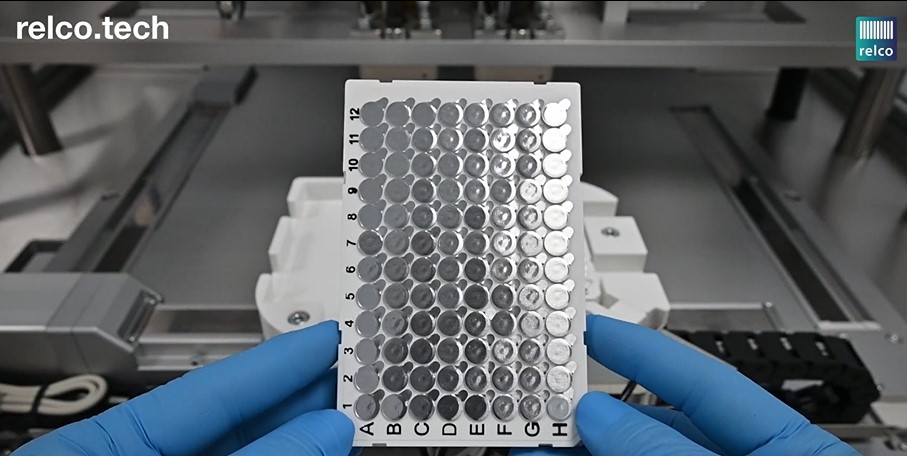
Sealing 96-well plates using traditional induction sealing systems often results in inconsistent seals, thermal damage, or plate deformation. These failures are typically caused by single heated tooling, uneven pressure distribution, and uncontrolled heat transfer.
Relco has addressed these issues by engineering a customized Punch & Seal induction sealing system specifically designed to treat each well independently, delivering consistent, hermetic seals without overheating.
This article explains how the Relco Punch & Seal system works, why it outperforms conventional sealing methods, and where it is best applied.
The Industry Problem: Why 96-Well Plate Sealing Fails
Based on real-world production and laboratory environments, sealing failures in 96-well plates most commonly occur due to:
- Heat transfer from hot metal tooling into the plate
- Inconsistent pressure across multiple wells
- Foil distortion or partial adhesion
- Seal degradation during cooling
These challenges increase reject rates, reduce sample integrity, and limit suitability for aseptic or ESL filling environments.
Relco’s Engineering Solution: The Punch & Seal System
What Is Punch & Seal?
The Relco Punch & Seal system is a capless induction sealing unit designed for OEM filling and assembly equipment. It uses a patented single-stroke process to:
- Die-cut foil from reel-fed stock
- Hold the foil using vacuum
- Transport and locate the foil precisely
- Induction weld the foil to the container
- Maintain pressure during cooling
All of these steps occur in one vertical downward motion.
How Punch & Seal Works (Technical Detail)
Step-by-Step Process
- Foil Feeding & Die Cutting
Foil is continuously fed from a reel and die-cut into the required profile for the container or well. - Vacuum Foil Retention
A vacuum holds the die-cut foil securely on the sealing head, ensuring precise positioning. - Single Vertical Stroke Placement
The head moves downward, transporting the foil directly onto the container neck or well opening. - Induction Sealing (Cold Head Technology)
- Induction energy generates heat within the foil itself
- The sealing head remains cold
- Typical sealing time: 0.3–0.7 seconds
- Cooling Under Pressure
After induction power is switched off, pressure is maintained to allow controlled cooling and ensure hermetic seal integrity.
Why Punch & Seal Is Different from Conventional Induction Sealers
| Feature | Conventional Systems | Relco Punch & Seal |
|---|---|---|
| Heat Source | Heated metal tooling | Heat generated in foil |
| Tool Temperature | Hot | Cold |
| Sealing Method | Multi-step | Single stroke |
| Foil Placement | Manual or mechanical | Vacuum-controlled |
| 96-Well Reliability | Inconsistent | Consistent, independent sealing |
| Aseptic Compatibility | Limited | Fully compatible |
This design eliminates overheating and enables repeatable, high-integrity sealing.
Optimised for 96-Well Plates
The Punch & Seal system is particularly effective for 96-well plate sealing because:
- Each well is treated independently
- No cumulative heat buildup occurs
- Pressure and induction are precisely controlled
- Seal failure rates are dramatically reduced
This makes it suitable for laboratory research, diagnostics, pharmaceutical development, and biotech applications.
Capless Hermetic Sealing
Punch & Seal enables hermetic seals without the need for caps or screw threads, making it suitable for:
- Vials
- Tubes
- Valves
- Closures
- Multi-well formats
This reduces component count, simplifies production, and improves sterility control.
Custom-Built for OEM Integration
Every Relco Punch & Seal unit is custom engineered to match the customer’s application:
- Configurations from single-head to 12-head systems
- Linear or rotary indexing equipment
- Aseptic and ESL filling systems
- Bare-bone mechanical units or full systems with:
- Controls
- Operating software
- Integration support
This flexibility ensures compatibility with almost any OEM filling or assembly line.
Safety, Cleanliness, and Compliance
Because the system contains no heated tooling:
- Operator safety is improved
- Risk of contamination is reduced
- Cleaning and maintenance are simplified
- The system is suitable for sterile environments
Key Benefits Summary
- Reliable hermetic sealing
- No overheating of 96-well plates
- Capless induction sealing
- Fast cycle times (0.3–0.7 seconds)
- Cold head technology
- Custom OEM integration
- Aseptic and ESL compatibility
Conclusion
The Relco Punch & Seal induction sealing system represents a proven engineering solution to one of the most persistent problems in 96-well plate sealing. By combining single-stroke precision, vacuum foil control, and cold head induction technology, it delivers consistent, hermetic seals without the risks associated with traditional systems.
For manufacturers and laboratories requiring reliability, sterility, and scalability, Punch & Seal sets a new standard in induction sealing performance.
Frequently Asked Questions (FAQ)
What is the Relco Punch & Seal system?
The Relco Punch & Seal system is a capless induction sealing technology that die-cuts foil from reel-fed stock, positions it using vacuum, and induction welds it onto a container or well in a single vertical stroke. It is designed for high-precision, hermetic sealing without heated tooling.
How does Punch & Seal differ from traditional induction sealing?
Traditional induction sealing uses heated metal tooling to transfer heat to the foil, which can cause overheating and inconsistent seals. Punch & Seal generates heat within the foil itself using induction, while the sealing head remains cold, eliminating thermal damage and improving seal consistency.
Is Punch & Seal suitable for sealing 96-well plates?
Yes. Punch & Seal is particularly well suited for 96-well plate sealing because each well is treated independently. This prevents uneven pressure, heat buildup, and seal failures commonly seen with conventional systems.
Does Punch & Seal cause overheating of plates or samples?
No. Because the sealing head remains cold and heat is generated only within the foil during induction, Punch & Seal prevents overheating, plate deformation, and thermal damage to sensitive samples.
What sealing times are typical for the Punch & Seal system?
Typical induction sealing times range from 0.3 to 0.7 seconds, depending on foil material, container type, and application requirements.
Can Punch & Seal create a hermetic seal without a cap?
Yes. Punch & Seal enables capless hermetic sealing, meaning a foil seal can be applied directly to containers such as vials, tubes, valves, closures, or wells without requiring a cap or screw thread.
Is the Punch & Seal system compatible with aseptic filling environments?
Yes. Punch & Seal can be built to operate within aseptic and ESL filling systems, allowing containers to be hermetically sealed while still inside the sterile environment.
What types of equipment can Punch & Seal integrate with?
Punch & Seal systems are designed for OEM filling and assembly equipment, including both linear and rotary indexing machines. Each unit is custom-built to match the customer’s production line.
How many sealing heads can a Punch & Seal system have?
Systems can be configured from single-head or twin-head units up to 12-head systems, depending on throughput and application requirements.
Is the Punch & Seal system customisable?
Yes. Every Relco Punch & Seal unit is custom engineered. Configurations range from bare-bones mechanical units to fully integrated systems with control hardware and operating software.
What industries commonly use Punch & Seal technology?
Punch & Seal is commonly used in:
- Pharmaceutical manufacturing
- Biotechnology
- Diagnostics
- Laboratory research
- Medical device assembly
Any application requiring reliable, hermetic, capless induction sealing can benefit from the system.
Is Punch & Seal safe and clean to operate?
Yes. Because there is no heated tooling inside the machine, Punch & Seal offers improved operator safety, reduced contamination risk, and easier cleaning and maintenance.